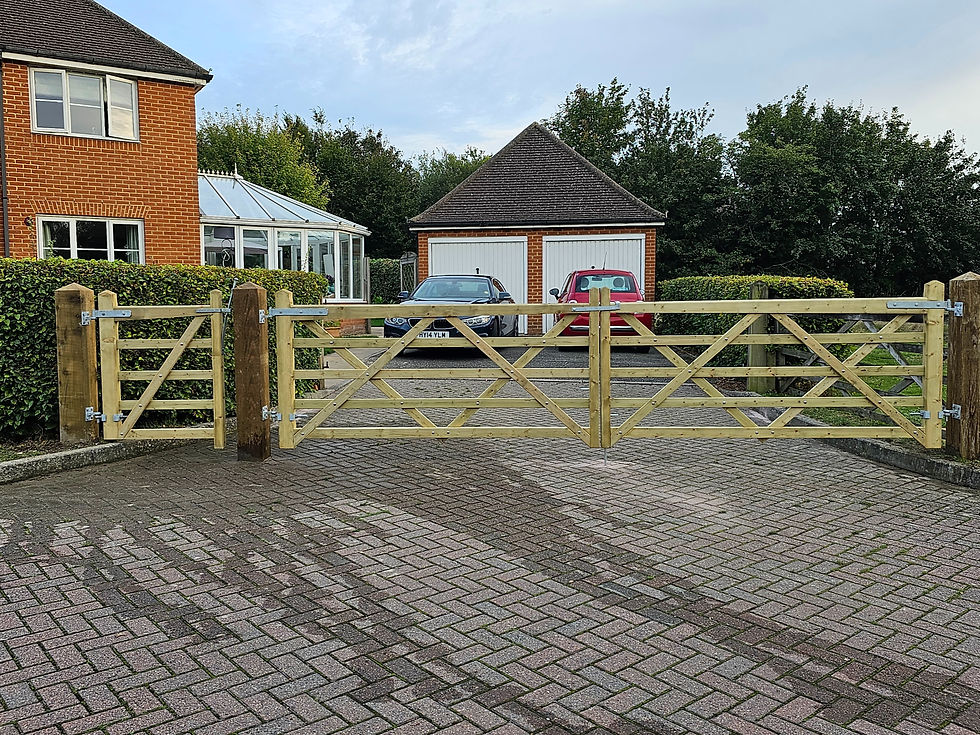
How to Choose Between Oak and Iroko for Your Driveway Gates

So, you’ve decided that you want hardwood driveway gates to elevate your home. But which wood to choose: Iroko or Oak? It can be a tough one, as both are premium hardwoods, and both are widely used for bespoke gates, looking fantastic whilst doing so. And yet, while they both will suffice, they do have subtle differences that better suit different properties, lifestyles and expectations.
Here at PQF Assured, this is a question that we get asked all the time. Choosing between traditional oak gates Kent homeowners love, and the iroko gates Kent properties increasingly opt for, is much less about which timber is ‘better’ and more about which suits you and your home best. Let’s take a look at what these differences are, so that you can make an informed decision for yourself.
First things first: both are proper hardwoods
Before we begin, it is worth saying this. Oak and Iroko are both excellent materials for driveway gates. They are both strong, durable, and naturally resilient to the elements, and perform beautifully when used for bespoke joinery. Whichever you choose, you’re already a long way ahead of the standard softwood or mass-produced alternatives.
The decision will ultimately be personal, as it depends on appearance, how the gate is used over time, and how well each timber type complements the property it sits next to.

Oak driveway gates: traditional, solid & full of character
When you think of British wooden construction, you think of oak. It has a long and winding history within the construction industry and portrays a sense of heritage. For many properties in Kent, especially period homes, countryside cottages, and farmhouses, oak looks and feels like it belongs. In these types of settings, an oak driveway gate doesn’t look added on, rather that it has always been there, as part of the landscape as the hedges and the grass and the trees themselves!
Visually, oak has a strong character. The grain tends to be bold and loudly expressive, with visible knots that are part of the charm that people choose it for. When newly installed, it has a warm, light tone that gradually darkens as it ages. If left untreated, it weathers down to a soft silvery-grey. Many homeowners choose it for this natural aging process, as it suits older, weather-worn buildings beautifully.
The downside to this all-natural process is that oak does move. As a natural timber it responds to any changes in the air, be it temperature or humidity, perhaps more so than some other woods. This isn't necessarily a flaw, but it does mean that oak driveway gates need to be properly designed, constructed and installed with this in mind, which is where bespoke work really comes into play.
Oak driveway gates will work when:
The property is traditional or rural
You want visible grain & natural variation.
A classic, timeless look that matters more than uniformity.
The gate will be a visual centrepiece for an entrance

Iroko gates: refined, strong & understated
Iroko is sometimes marketed as a modern alternative to oak, but we think that it is underselling it slightly. It is so much more than merely an alternative. Iroko is a premium hardwood in its own right, and one that is becoming more and more popular in modern or mixed-style homes. For new builds and 21st century homes, it is iroko gates that Kent homeowners are asking for.
On a purely visual basis, iroko is a lot smoother and more uniform than oak, with a tighter grain and a surface finish that is noticeably more consistent. To some, this will appear more refined, to others, it will appear boring - it is all about personal taste. Fresh iroko has a golden brown colouring that ages over time, developing a worn patina the longer it is in situ. It can be left to weather in this way, or can be finished to maintain its pristine condition, depending on what look you are after.
One of the key selling points for iroko is its natural stability. Because of its density and high oil content, it tends to move a lot less than oak does, once installed. For sleek, modern gate designs that rely on clean lines and minimal detailing - this is essential.
For new builds or architecture-driven homes, barn conversions or projects that straddle the traditional and the contemporary, iroko is there to strike a perfect balance. It feels premium without leaning too much onto the rustic side of things.
Iroko gates work when:
The property is contemporary in design, or has been recently renovated
Clean lines & minimal detail is important
You want a rich colour, without heavy grain variation
Long term stability is a priority
Matching the timber to the property
As you can see, even these recommendations aren’t hard and fast rules, and the difference between the two is slight enough that both can technically be used interchangeably. Choosing between oak and iroko for your hardwood driveway gates is as much about your personal taste as it is about the context in which they will be used.
Matching the timber to the property
There are some material combinations that are classics: bricks and black steel, concrete and glass, natural stone and wood. In this vein, a period home with brickwork, stone detailing and mature landscaping will almost always feel more complete with an oak gate. The timber itself will echo the age and textures found around it in such a setting.
In contrast, a modern home with glass facades, sharp architectural lines and rendered walls may look visually cluttered with oak, whereas iroko would slot in seamlessly.
That doesn’t mean that rules aren’t there to be broken. We've seen iroko used to a stunning effect on older properties, where owners wanted a clear delineation between old and new, or when oak is used on modern houses as deliberate textured contrast. The key here is that the choice is intentional, not accidental.
When we design hardwood driveway gates, we look at the whole picture. The home and the driveway, yes, but also the surroundings and how the gate will be used on a daily basis. This kind of attention means all the difference, meaning that you have the gate you need, long after the novelty of having the one that you want has worn off.
Maintenance & Longevity
As they are both hardwoods, both iroko and oak will last a long time, when they are installed and cared for properly. It is not the longevity that sets these two woods apart, but rather the way in which they age.
Oak will change more noticeably over time. Some homeowners love that journey, others prefer to manage it with finishes. Iroko tends to age more evenly, which appeals to those who prefer consistency. Neither is a high-maintenance option in the context of hardwood gates, but both reward sensible care.
Which hardwood driveway gates are best for me?
The best choice is always the one that feels like it belongs to you, and which you can see welcoming you home after a long day.
Here at PQF Assured, we can help you discover which gate type will suit you best, in terms of aesthetics, design (sliding or swing? Automatic, electric or manual?) and help you fit it into your property as if it had always been there. Get in touch with one of our experienced team members today to get started.